Solar Energy Systems Built for Agricultural Irrigation and Livestock
Infrastructure-Independent, for Commercial or Individual Farmers
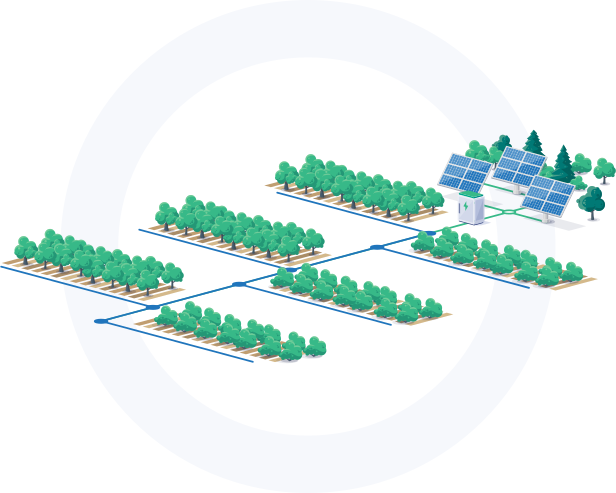
Example Installations
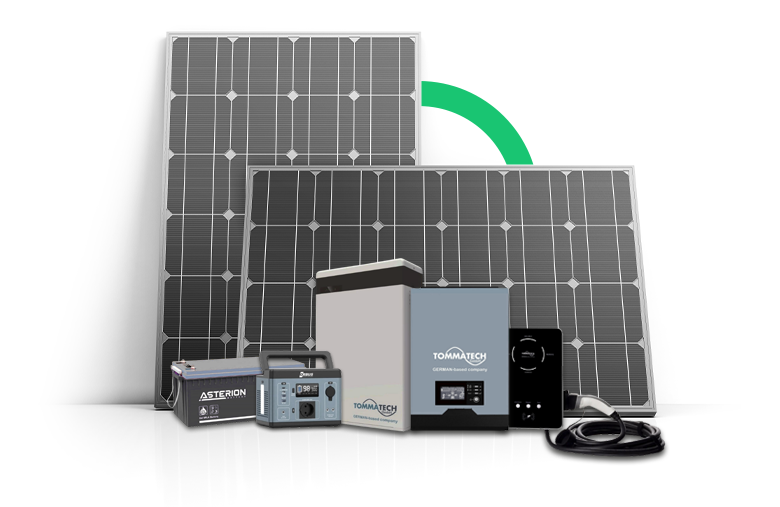
System Equipment
Power Generation
Solar Panels
Inverter
Off-Grid/Hybrid
Energy Storage
Optional
Control Unit
PV Distribution Panel
Metering
Optional
Other
Consumables
Key Features
- Low Investment Cost
- Expandable System
- Option to Sell to the Grid
- Use in Rural Areas
- Easy Maintenance & Operation

What Are Agricultural Solar Energy Systems?
These are solar energy projects deployed to meet the electricity needs of farmland far from the grid. Submersible pumps run in borehole wells to irrigate farmland. Water drilling taps groundwater so that farmland can yield abundant crops. Water drilling is the work done to bring underground water to the surface. Yields on unirrigated land fall considerably.
Much farmland has no electricity at all, and on some farmland the electricity bills are so high that submersible pumps cannot be used. With solar-powered agricultural irrigation systems, our farmers can supply the water their fields need at no running cost.
Thanks to solar energy, our farmers can grow more productive crops with peace of mind, without worrying about the cost of an electricity bill. At that point, solar energy systems become the farmer’s greatest ally.
Advantages of Agricultural Solar Energy Systems
Beyond the financial advantages they bring investors, they deliver major benefits such as a lower environmental impact and energy independence, letting them contribute to a sustainable energy future.
- Savings on Your Energy Bill
There is no dependence on the grid. Agricultural systems are supported by the government. - Continuity
They can supply energy with no time limit. - Investment
Compared with the generators and diesel pump engines used for electricity in the fields, the investment turns a profit in a very short time.
Why Site Selection Matters in Solar-Powered Agricultural Irrigation
Because farmland has no mains electricity, agricultural irrigation is run on fossil-fueled power. That power is both costly and noisy. Agricultural irrigation powered by solar, by contrast, is more economical on every count. It is also quiet and environmentally friendly.
Not all of the energy coming from the sun reaches the earth’s surface. 25% of the incoming radiation is reflected back by the atmosphere and clouds, and 25% is scattered through the atmosphere in what is called diffusion. The atmosphere absorbs 15%, while 8% is reflected from the earth back into space by albedo — the capacity to reflect electromagnetic energy, that is, the reflectivity of the surface — and 27% heats the earth.
Only 1 part in 2,000,000 of the energy the sun radiates reaches the earth. Even that 1% share of the sun, an inexhaustible energy source, is powerful enough to heat our entire planet. Solar energy raises the earth’s temperature, and “life” is born. Solar energy does not only heat our planet; it brings a great many “solutions” with it. One more of those applications is agriculture.
Water management performs a critical role: when a country’s stored water resources are used as efficiently as possible, harm to the environment and to other natural resources is avoided. It produces the information needed for crop irrigation and drainage systems to operate efficiently under field conditions. Work continues to improve performance in irrigated agriculture by developing new technologies for designing and operating new irrigation systems. Research is carried out to increase irrigation efficiency and to return irrigation water and other wastewater sources to agriculture, reducing the risk of excess water demand in irrigated areas.
Choosing an Agricultural Irrigation Pump
What matters in agricultural irrigation is using a pump that can meet the demand. Different types of pump are produced for that reason.
Together with solar panels, submersible pumps can be run in areas with no electricity to meet the demand for water.
Another point to watch when choosing a pump is where the water will be drawn from and the discharge distance. A pump is chosen by calculating the distances the water will travel once it comes out. Every pump has its own characteristic curve.
Agricultural irrigation pump curves show:
- The pump’s discharge distance
- The volume of water it will deliver at that distance
- The outlet size of the pump in inches
- The pump’s HP (power) rating
In field irrigation, solar panels, a drive inverter and mounting structures are installed for the irrigation pumps according to their horsepower, and the energy the pumps consume is generated by the solar panels. That way, agricultural irrigation pumps are run on solar energy during the day, between 8:00 a.m. and 6:00 p.m. Because field irrigation pumps differ in their energy consumption, the number of solar panels is determined on the basis of pump horsepower (hp).
Government Support for Solar-Powered Agricultural Irrigation
Certain financial institutions offer loans to cover the investment cost of solar-powered agricultural irrigation systems. That lets our farmers own a solar energy system without spending their own capital, comfortably repaying the loan from harvest to harvest at low interest.

Let Us Design
the System That Suits You Best
Fill in the request form to get support from our energy engineers.

Our engineers will contact you on 0(553) 532 9768 or 0(531) 011 4767. During the call they may ask you technical questions and request your full address for a detailed site survey.