Systems Independent from the Grid
For buildings without mains electricity
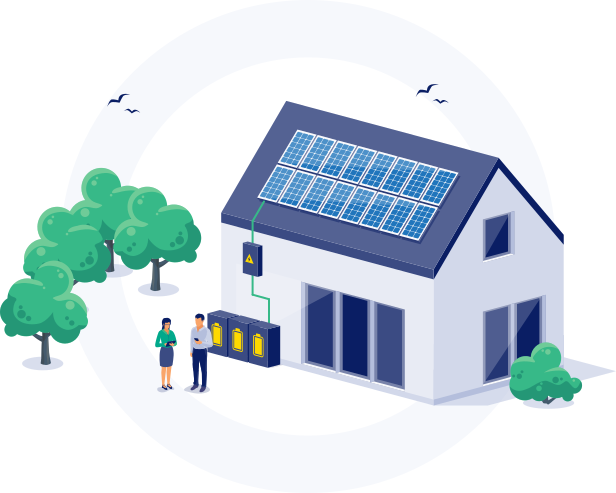
Example Installations
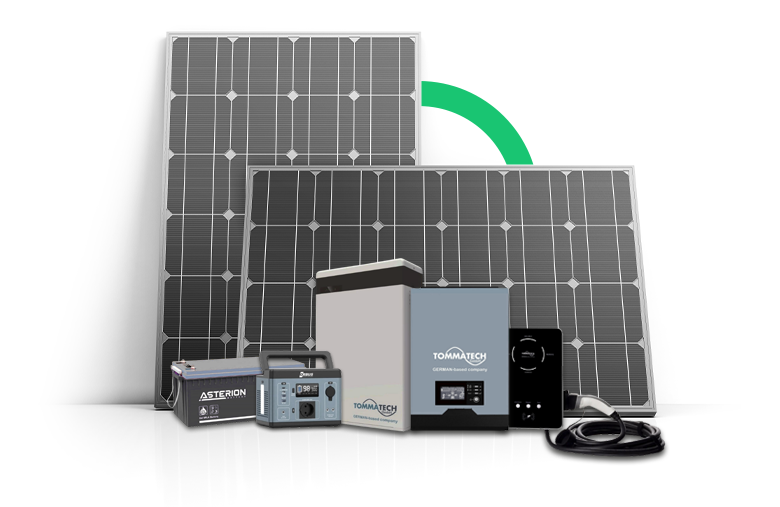
System Equipment
Power Generation
Solar Panels
Inverter
Off-Grid/Hybrid
Energy Storage
Battery
Control Unit
Inverter
Metering
None
Other
Consumables
Key Features
- Grid Independent
- Expandable System
- Unaffected by Outages
- Storable Energy
- Easy Maintenance & Operation

What Is an OFF GRID System?
Off Grid systems run independently of the grid, with storage. They are most often chosen for summer houses, vineyard cottages, campsites and similar locations; the energy the panels produce is stored in a battery bank and kept ready for use. Where there is no grid line, or no functioning electricity network, the soundest solution is an Off Grid system correctly sized to the demand. Because it runs independently of the grid, it has to be designed to generate enough power year-round and to have the battery capacity to cover the site’s needs even when there is no sunlight. Installations of this kind are common at highland and mountain houses, farms, signaling systems, remote information systems (highway signage), base stations and the like.
These are solar energy projects deployed where mains electricity is not available or where the power supply is frequently interrupted. Grid-independent systems may be called island systems, Off Grid systems or battery-based systems.
The direct current electricity produced by the solar panels is stored in batteries with the help of charge controllers. The stored energy waits ready for use. Once the batteries are full during daylight hours, the remaining energy feeds the electrical loads directly. To run those loads, the direct current stored in the batteries has to be converted into the alternating current used on the grid. An inverter has to be added to the system for that step.
Advantages of Grid-Independent (Off Grid) Solar Energy Systems
Beyond the financial advantages they bring investors, they deliver major benefits such as a lower environmental impact and energy independence, letting them contribute to a sustainable energy future.
- Savings on Your Energy Bill
With a solar energy system, part or all of a home or business’s electricity demand can be met by the solar panels. That translates into significant savings on energy bills. - Flexibility
Because the system can be sized to the space and capacity you want, it is inherently flexible. Where there is enough space, the installed capacity can be increased by adding new panels. - Environmental Responsibility and a Green Image
Solar is a clean, environmentally friendly energy source. Using this system, you can reduce your carbon footprint and contribute to environmental sustainability. Using green energy also builds an environmentally responsible image. - Energy Independence and Security
A solar energy system lets you meet part or all of your own electricity demand and reach energy independence. At the same time, staying connected to the grid keeps your supply secure. - Increased Property Value
Installing a solar energy system raises the value of your home or business. Solar energy systems are seen as a valuable investment in energy efficiency and environmental sustainability. - Access to Government Incentives and Rebates
Governments periodically offer incentives and rebates to encourage the use of solar energy. Taking advantage of them, you can install solar energy systems at a lower cost. - Social Responsibility and Contribution
Using solar energy reduces dependence on fossil fuels and lets you meet your social responsibility as an environmentally conscious energy user. - Expandable Energy Storage
Generation capacity can be increased over time as conditions change. In Off Grid (storage-based) solar energy systems the choice of battery is critical and has to be analyzed carefully. With the right battery bank, the system will be long-lived. Because these systems require no permit from the electricity distribution company you are connected to, they can be commissioned very quickly.
Why System Design Matters in Grid-Independent (Off Grid) Solar Energy Systems
The first step is to replace the existing equipment at the site where the system will be used with energy-efficient products. That brings down the amount of energy consumed.
Next, daily consumption has to be measured. To take that measurement, list which appliances are used at the installation site and roughly how many hours a day each one runs. That list lets you establish the property’s daily and weekly energy demand and size the system accordingly.
Whether the site being designed for is a summer house or a year-round residence also has a serious effect on the design and the cost. If the property will be used all year, the panel array is designed around the worst seasonal conditions.
If the property is seasonal or a summer house, the first thing to establish is which months it is used in. Sizing is then calculated on the basis of summer irradiation values. The inverter has to be sized for the voltage and power matching the instantaneous draw of the equipment that will be run. The most important consideration in choosing an inverter is whether it can handle the inrush current of the appliances in use — motor-driven equipment such as refrigerators. The inverter supply has to be rated to handle that current given the device’s characteristics.
If the system is going on a roof, the roof’s orientation and pitch have to be calculated in detail. The equipment has to be mounted so that it does not damage the roof’s insulation.
If the system is going in a garden, it can be mounted on fixed frames or on sun-tracking mounts. Depending on whether the tracker is single-axis or dual-axis, the energy generated can be increased by 15% to 35%.
When energy is carried as DC, the amount lost over distance can reach significant levels. For that reason the distance between the devices involved — solar panel, battery, inverter — has to be kept to a minimum.
Where Grid-Independent (Off Grid) Solar Energy Systems Are Used
Solar is the fastest-growing renewable energy source in the world today. Its low cost, the ease with which it can be deployed and the speed at which the money invested comes back as return are what make it the preferred choice.
- Allotment gardens and vineyard cottages
- Highland and mountain houses
- Boats and caravans
- Base stations
- Signaling and highway information systems
- Security camera systems
- Picnic and camping grounds
- Farms and livestock facilities with no grid connection
- Agricultural irrigation systems far from the grid

Let Us Design
the System That Suits You Best
Fill in the request form to get support from our energy engineers.

Our engineers will contact you on 0(553) 532 9768 or 0(531) 011 4767. During the call they may ask you technical questions and request your full address for a detailed site survey.